Mapping the materials used in tires reveals just how much work remains to be done: barely more than 31% of renewable and recycled materials on average are integrated into Michelin tires. Despite that figure, the Group is maintaining its ambitious target of 40% renewable and recycled materials in its tires by 2030 and 100% by 2050, and for now, mainly thanks to natural rubber. That will mean tackling immense human, technological, economic, environmental, and social challenges.
Michelin does have a number of strengths that will help it do just that, including its unique innovation power and an approach to the circular economy that is already solidly rooted within the Group.
Avoid, Reduce, Reuse, Recycle and Renew: Michelin uses these processes to make better use of natural resources.
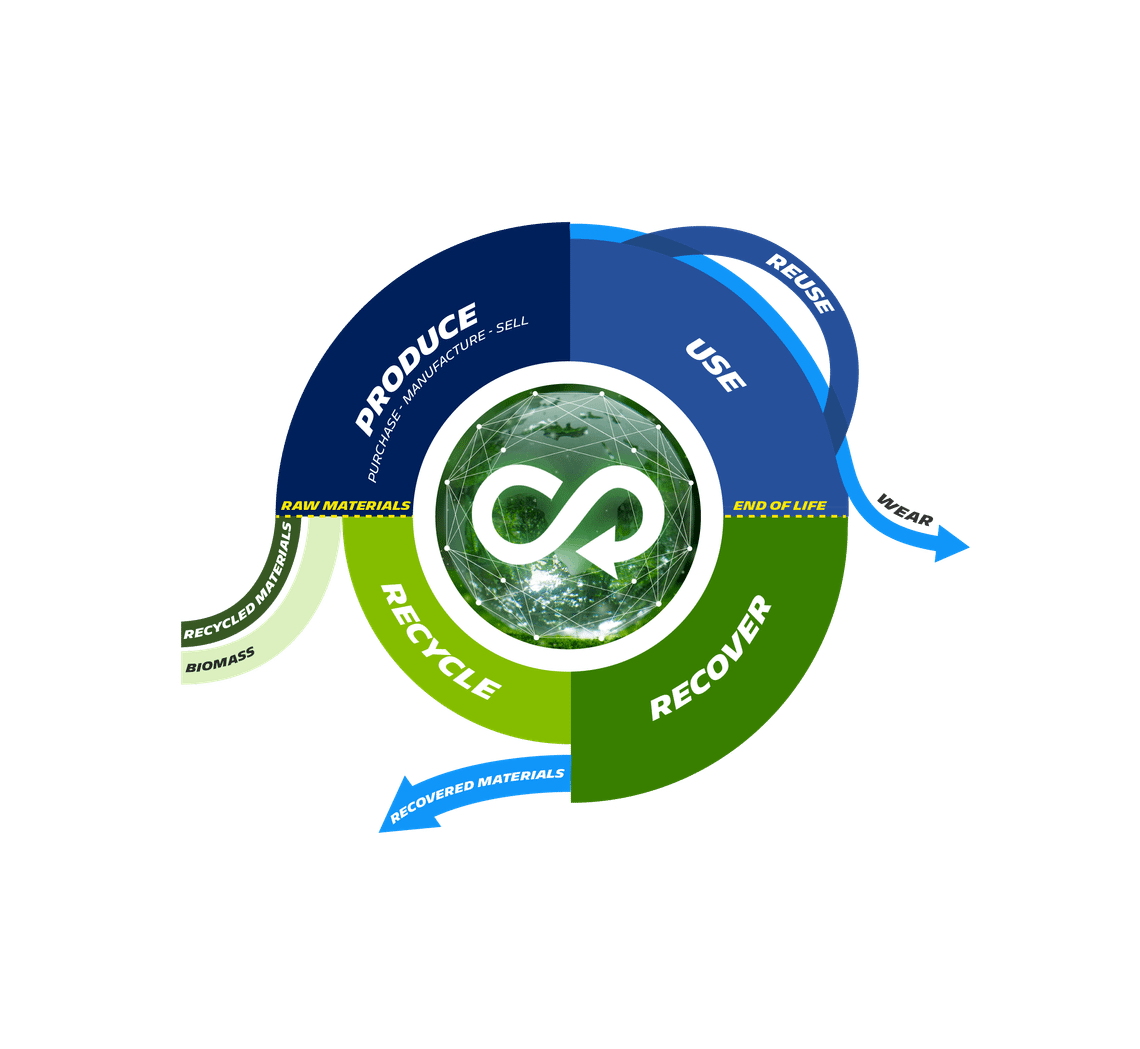
Circular economy: our strategy
In keeping with its pioneering spirit and its conviction that a collective dynamic is essential, Michelin is committed to showing the way forwards and developing new circular value chains.
What is a circular value chain?
A circular value chain aims to create virtuous cycles that continuously protect the environment through the reuse and recycling of resources.
A value chain involves 2 types of raw materials:
Raw materials from renewable biosourced materials like natural rubber,
Raw materials produced from recycled materials both from end-of-life tires and from other industries - e.g. plastics, textile, automotive, etc.
an array of interdependent challenges
Transitioning to a circular economy and moving away from fossil fuels represents a true revolution in which innovation and adaptation will play a crucial role.
The cost of fossil materials is much lower than the costs we will have to face to access new renewable and recycled materials. Indeed, the latter will require the development of new technologies, and the energy needed to produce them will often be greater. Incorporating these renewable or recycled materials will therefore inevitably lead to a significant increase in initial costs; an economic reality need to be taking into account now. Acceptance of these economic impacts by the market will thus be a major challenge for the implementation of the circular economy.
In this highly challenging economic context, we wish to examine as many options as possible to assess their environmental impacts and enable us to choose the most relevant ones.
Life cycle analysis plays an essential role in this process by measuring the impact of each phase of the cycle. Particular attention will be paid to quantifying CO2 emissions and ensuring that the technologies selected actually reduce them. This is the economic and environmental compromise that we collectively need to achieve.
Another important challenge is recycling end-of-life tires into materials that can then be used in new tires. This is what we call a closed loop. Michelin has already been working for years to implement effective solutions, such as eco-organizations facilitating the collection of used tires; the goal being to optimize recovery flows in order to maximise the reuse of materials, particularly in the manufacture of new tires.
For Michelin, collective intelligence and coalitions will play a crucial role in the emergence of new circular value chains. Supporting circular economy initiatives means commitments and collective efforts on the part of all stakeholders, from governments and businesses to consumers, in the form of new legal frameworks, multi-industry coalitions, and more... all of which will need to take local realities into account. We need a highly agile “glocal” approach.
Michelin is creating an operational direction to promote the circular economy
Because Michelin believes that the circular economy cannot be adopted in isolation, it has created an Operational Direction dedicated to circular solutions. Its mission: interacting with a wide range of stakeholders in the energy and materials industries to foster the formation of coalitions. Startups, big companies in industries as varied as construction, food, toys, and textiles, competitors, public agencies, research institutions... The emergence of circular value chains requires cooperation across different industries to identify synergies and facilitate the development of new technologies. What value chains are linked to our raw materials, in what industries could they be recycled, at what price, for what CO2 savings, what new regulations should we promote...? So many questions that we need to address now, and which highlight the importance of a holistic approach to tackling the challenges of the circular economy.
Interacting with a wide range of stakeholders in the energy and materials sectors to foster the formation of coalitions.
From exploration to the invention of new business models...
While a collective dynamic is essential to foster the emergence of new circular value chains, exploration is no less crucial, with a focus not on solutions but on options. Michelin is exploring several alternatives for the same category of materials, evaluating each one's probability of economic and environmental success, its ability to secure raw materials, the associated regulatory challenges, and more. This exploratory approach means that it can not only flexibly and effectively manage a portfolio of options but also invent new business models. The joint venture Antin-Enviro and the BioButterfly project are two representative examples of the Group's approach
Antin-Enviro for used tire recycling
In Europe alone, 3.5 million metric tons of tires are now scrapped every year. Why not recover certain raw materials from those used tires? The journey began back in 2020, when Michelin decided to support Enviro, a Swedish startup that specializes in pyrolysis technology, which can be used to extract recycled carbon black as well as oils that are essential components of new tires. Three years later, Scandinavian Enviro Systems and Antin Infrastructure Partners announced the creation of a joint venture that would become the world's first industrial-scale tire recycling group. In 2024, the two partners decided to invest in building their first tire recycling factory, with an initial goal of processing some 35,000 metric tons of end-of-life tires per year. In this context, Michelin is continuing to proactively support the development of end-of-life tire recycling ecosystems and is committed to collaborating with the joint venture's future developments.
Did you know?
Michelin just launched its recycling service in Chile through its factory in the Chilean region of Antofagasta. Once the end-of-life tires are collected from local mining customers, they are shredded, ground, and turned into a raw material that can be reused to produce new tires and other products—further proof of the Group's commitment to recycling end-of-life tires and to the circular economy.
BioButterfly to produce biosourced butadiene
The BioButterfly project, founded in late 2012 by Michelin, in partnership with IFP Energies Nouvelles and Axens and with support from the French ecological transition agency ADEME, aims to replace petroleum-based butadiene with butadiene made from ethanol extracted from biomass (plants). Butadiene, along with styrene, is one of the components of the synthetic rubber used in tire production.
In 2024, Michelin, IFPEN, and Axens opened the first industrial demonstrator in France to produce butadiene from bioethanol. For BioButterfly, that was a major step towards the development of industrial production of biosourced synthetic elastomers. We are now moving into the next phase: seeking partners to operate and finance factories based on the model developed by BioButterfly. The first factory will be selected based on economic and environmental criteria, as well as the accessibility of ethanol, which is crucial for manufacturing renewable butadiene.
Recovered carbon black: an example of cross-industry collaboration
Using recovered carbon black is crucial to achieving products made from 100% renewable and recycled materials by 2050. To further that goal, the Michelin Group and the Bridgestone Corporation published a technical white paper to share the results of their work with the stakeholders in the cRB recovered Carbon Black community with the goal of preparing a draft international standard to increase the use of recycled carbon black in tires.
Michelin's expertise in materials: another asset for the circular economy
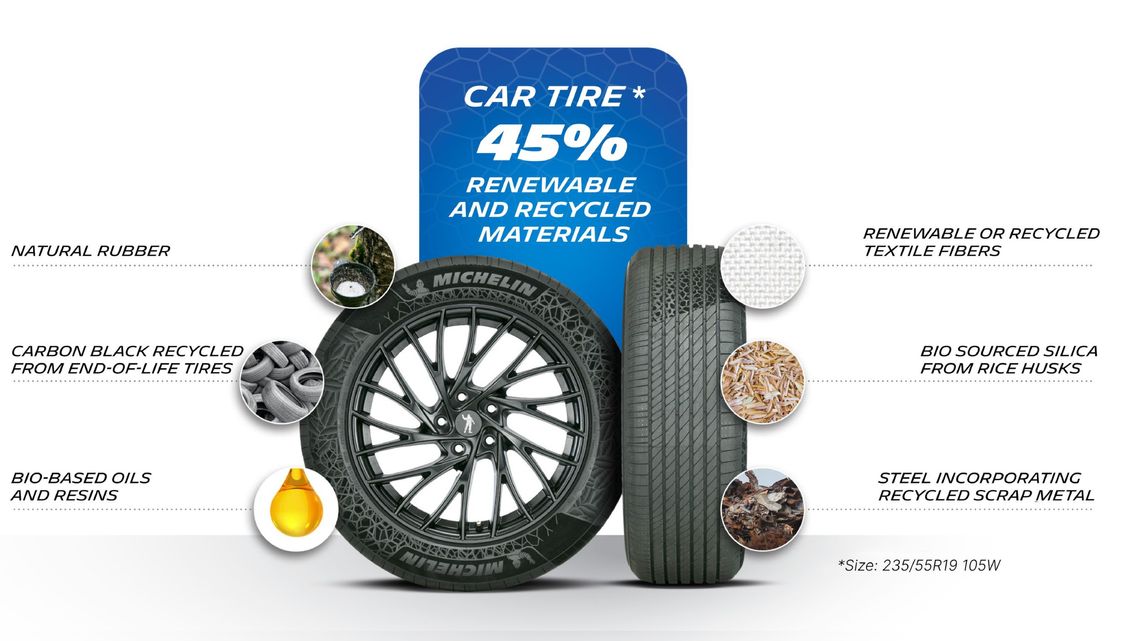
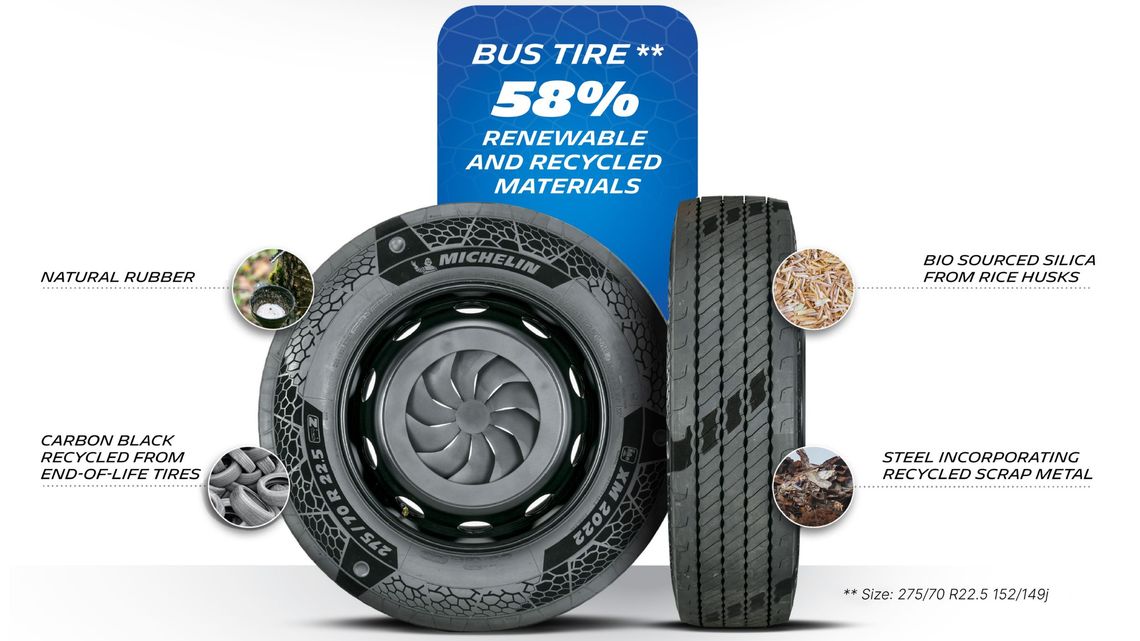
To ensure the success of the circular economy revolution, Michelin is also counting on one of its major assets: its unrivaled expertise in materials science and complex industrial processes. In 2022, the Group unveiled the first two tires approved for road use (car and bus), incorporating respectively 45% and 58% renewable and recycled materials*, an achievement that is all the more remarkable since Michelin managed to maintain the exceptional performance levels associated with its Brand.
*This is a percentage of “segregated” renewable and recycled materials. Their incorporation does not negatively impact either the tires’ performance or their environmental impact.
As it always has, Michelin continues to use motorsports as an arena to test and accelerate innovative technologies. Beyond trophies, auto racing enables the Group to enhance its technological leadership for the benefit of the environment.
Did you know that the rear tires for MotoE (the electric motorcycle world championship), which can handle speeds of over 250 kph, also incorporate more than 50% renewable and recycled raw materials sourced from orange peel, pine resin, and used tires? And at the most recent 24 Hours of Le Mans race, Michelin also presented a motorsport tire that comprises 71% renewable and recycled materials, designed for the Mission H24 prototype and the Porsche ePerformance.

Recognizing the urgent need to act for the planet and its inhabitants, Michelin is mobilizing to promote the circular economy. The Group will continue to draw on its innovation power and its expertise, as it has always done. However, that alone will not be enough to take on the vast challenges of circularity. Exploring, daring, inventing new business models, creating multi-industry alliances... it's time for a collective revolution, and Michelin is already a player in that revolution. How about you? Are you ready to commit?