Stock value -- --%

All-sustainable, anchored in Michelin’s strategy

The world is faced with multiple large-scale and urgent challenges, on both an environmental and a social level. Historically recognized for its social and societal commitment, Michelin has embraced an "All-sustainable" approach to evolve its growth model towards an equitable balance between human, economic and environmental issues.  

  • No development project can be imagined without considering all its economic, social and environmental impacts. Similarly, no single player can meet the collective challenges facing the world. Michelin's  "All-sustainable"approach exemplifies this multifaceted need for collaboration, which has become essential between all stakeholders, for the benefit of civil society as a whole.

    FLORENT MENEGAUX President of the Michelin Group
Michelin reinvents its growth model for a sustainable future
Today, the conclusion brooks no argument/the facts speak for themselves: humanity and all life on earth are in danger.  Fully aware of the threats facing the planet, Michelin is convinced that a sustainable future cannot be imagined without a growth model that takes planetary limits into consideration, and that is based on real social and societal responsibility.  
Motivated by this conviction, the Group thus crossed a new threshold in 2021 with its new strategic plan, Michelin in Motion, by setting objectives for 2030 (pdf) based on three pillars: People, Profit & Planet.  
Michelin is convinced that the equitable balance between human, economic and environmental concerns, which is at the core of its All-Sustainable approach, will ensure the success of its strategy. 
Results and ambitions by 2030
overview scorecard ppp 2026
This infographic presents the results achieved in 2025 and the targets set for 2030 across three pillars: People, Economic and Financial Performance, and Planet. For the People pillar, the employee engagement rate reached 84.4% in 2025, compared with a target of above 85%. The TRIR safety indicator stood at 4.48, against a target of below 2.5. The Diversity, Equity and Inclusion Index (IMDI) reached 86 out of 100, compared with a target of 95. The Net Promoter Score (NPS) was 45.5, with a target of 50. For the Economic and Financial Performance pillar, sales amounted to €26.0 billion in 2025, with a target of achieving 5% average annual growth between 2023 and 2030. ROCE reached 9.2%, compared with a target of above 10.5%. The Brand Vitality Index stood at 74, exceeding the target of 65. The Offer Vitality Index reached 27.7%, with a target of above 30%. For the Planet pillar, CO₂ emissions from manufacturing (Scopes 1 and 2) were reduced by 48% compared with 2019, surpassing the target of -47%. The Product Energy Efficiency Index reached 105.8, against a target of +10% compared with 2020. The Abrasion Performance Index stood at 108.4, with a target of 110. The share of renewable or recycled materials in tires reached 32%, compared with a target of 40%. The infographic provides an overview of the Group’s 2025 performance and its 2030 ambitions across the social, economic, and environmental dimensions of sustainable development.
  • Personal development and fulfillment 
    Be a global benchmark in terms of workplace safety, employee engagement, diversity and inclusion, and customer value creation.
  • Economic and financial performance 
    Pursue balanced, value-creating growth without which no sustained transformation is possible. 
  • Protection of the planet and its inhabitants 
    Reduce the environmental footprint of activities, products and services through life-cycle analysis and eco-design. 

Responsibility and transparency: two of Michelin’s golden rules

Deeply rooted in the Group’s culture, respect for people and for facts are two of the Groups key values. This is why Michelin opts for transparency, and responsible governance to achieve its goals and meet its commitments. This is realized in the work of several steering committees. 
  • The Corporate Social Responsibility Committee within the Supervisory Board - It has been overseeing the challenges faced by Michelin in terms of social responsibility since 2020. It also ensures the Group is appropriately engaged in terms of non-financial compliance and ethics.  

  • The Group Management Committee - This body certifies the sustainability guidance authored by various governance bodies - environment, human rights, health & safety, and sustainable finance - as well as those of an Ethics Committee, including the management of the Group's non-financial risks. 

  • The stakeholder committee - It creates a forum for open and constructive dialogue with people outside the company, from a variety of backgrounds, to track society’s changing expectations and to open up new development prospects.  
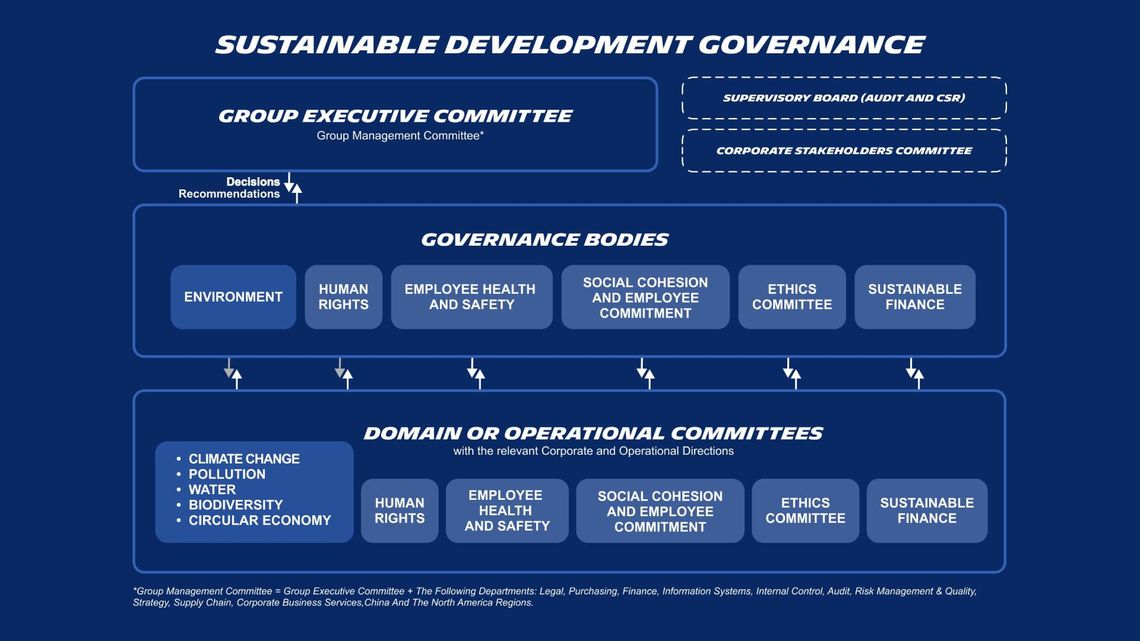
An "all-sustainable" governance
governance infographics

A recognized sustainable approach

Michelin is included in leading Socially Responsible Investment (SRI) indices.
Since 2003, the Group has been assessed by non-financial rating agencies for its environmental, social, and governance (ESG) performance. Today, Michelin is widely recognized for its strong commitment and the quality of its sustainability reporting.
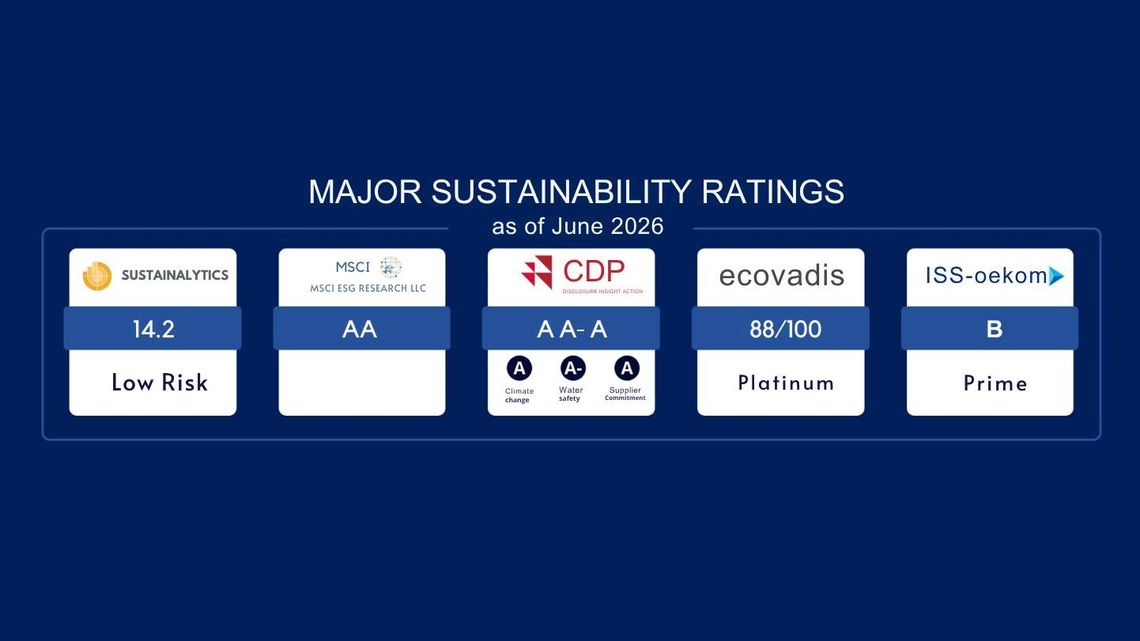
Non-financial ratings agencies' assessment
major sustainability ratings june 30 2026
This infographic presents the Group’s main ESG ratings and assessments as of June 2026, as evaluated by five external organizations. Sustainalytics assigned a score of 14.2, corresponding to a Low Risk rating. MSCI ESG Ratings awarded the Group an AA rating. CDP assigned a score of A for Climate Change, A- for Water Security, and A for Supplier Engagement, resulting in an overall assessment ranging from AA to A. EcoVadis awarded a score of 88/100 and a Platinum rating. ISS-oekom assigned a B rating and Prime status. Taken together, these assessments highlight positive external recognition of the Group’s performance in the areas of environmental, social, and governance (ESG) responsibility.

Helping to achieve the UN sustainable development goals
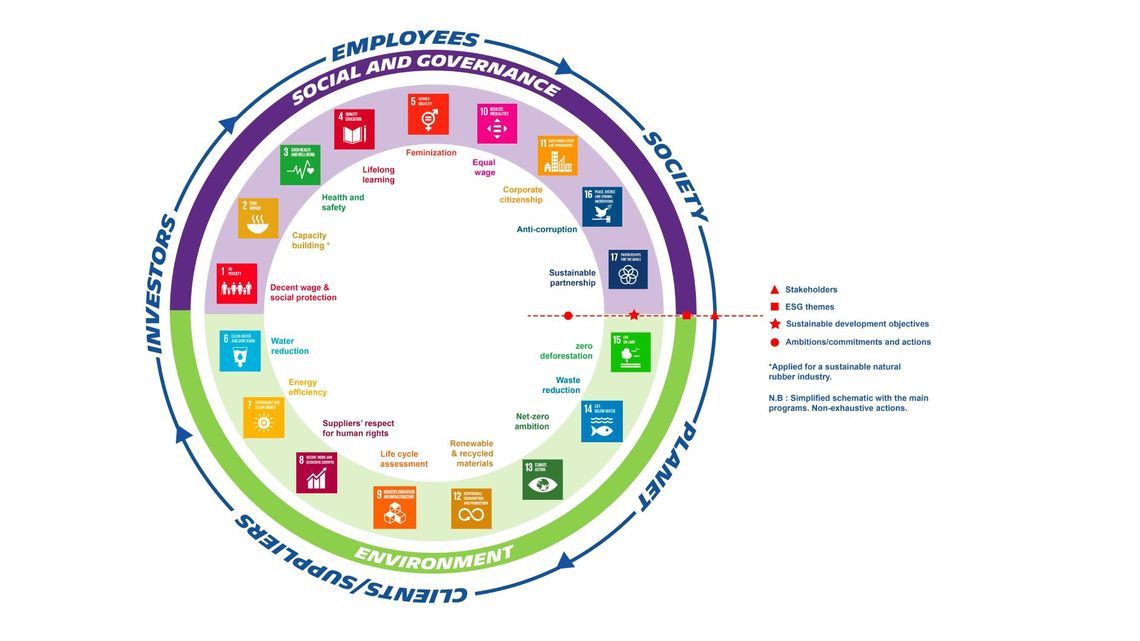
By assessing its actions and accomplishments in light of the United Nations’ Sustainable Development Goals, Michelin seeks to respond more effectively to increasing expectations from stakeholders (partners, customers, regulators, etc.) in relation to environmental and social topics. 
un sustainable development goals
This infographic illustrates how the company’s actions contribute to the United Nations 2030 Agenda for Sustainable Development. The 17 Sustainable Development Goals (SDGs) are grouped into three main areas: social and governance, environment, and economic growth. The key commitments highlighted include living wages and social protection, development assistance, health and safety, continuous training, greater representation of women, pay equity, community engagement, anti-corruption efforts, responsible business conduct, water conservation, energy efficiency, respect for human rights within the supplier network, life cycle assessment, the use of renewable and recycled materials, a net-zero emissions ambition, waste reduction, and zero deforestation. The infographic also shows the links between stakeholders, ESG topics, Sustainable Development Goals, and the company’s actions. A note explains that the diagram is a simplified representation of the main programs and includes an approach applied to a sustainable natural rubber supply chain.

Don't miss anything!

Sign up to receive email alerts to keep you informed of all the Group's activities. 

Candidates

Do you want a chance to explore the full scope of your potential and contribute to human progress and a more sustainable world?