Simple, useful, accessible… Preserving the spirit that made it a success
In 1948, the 2CV offered mobility freedom to millions of people. Eight decades later, now fully electric, this new concept reinterprets the 2CV and its original spirit. This revival extends the journey of two brands that, each in their own way, have helped democratize mobility. Today, Michelin and Citroën continue to share the same ambition: enabling as many people as possible to benefit from innovative, responsible, and accessible mobility.
Through its vision of a tire that is safe, simple, desirable, and connected, Michelin is developing solutions where technology enhances the driving experience without adding complexity.
When Seamless Intelligence Serves Simplicity
How can we remain true to the values of simplicity, accessibility, and intuitive use while embracing the electric and connected era? Michelin addresses this challenge through technologies that meet real-world needs: driving safely, gaining peace of mind, and controlling mobility costs. Among Michelin’s innovations is Touch Intelligence, the tire’s universal digital twin. Without any sensor embedded in the tire and relying solely on data already available within the vehicle, this technology can estimate grip, wear, pressure, load, and driving conditions in real time.
Vehicles equipped with this technology can adapt their behavior, optimize certain driver-assistance systems, and enhance safety when conditions become more demanding. This intelligence also makes it easier to monitor tire condition, anticipate maintenance, and avoid premature replacements. The result is greater safety, controlled operating costs, a more relaxed driving experience, and a positive environmental impact.
A Contemporary Tire Design Inspired by Heritage
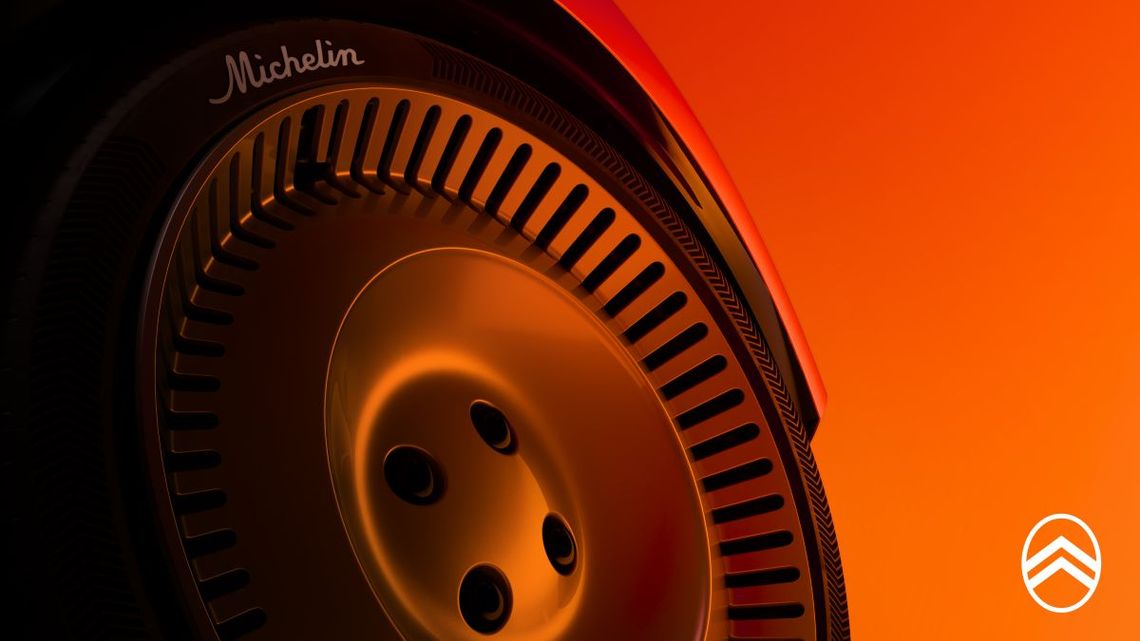
Michelin has created a bespoke design that combines its Heritage logo with Citroën’s iconic chevrons, resulting in a graphic expression that is both simple and elegant. The lettering, inspired by hand-drawn craftsmanship, evokes authenticity and the spirit of the original design. The chevrons are woven into a pattern and texture treatment that gives the tire a strong visual identity.
More than a technical component, the tire becomes a design object. It is a nod to the past that reinforces the vehicle’s uniqueness and celebrates the shared history between Michelin and Citroën.
The Story of a Small Car Destined for Greatness
The story began in 1922, when Michelin launched a“National Survey on the People’s Car” to better understand the mobility expectations of the French public. By 1934, these reflections helped pave the way for the TPV project, short for Toute Petite Voiture (“Very Small Car”), which would emerge a few years later.
Its ambition was revolutionary: to create a people’s car that was robust, economical, and affordable for everyone. Behind the project was a strong conviction that remains relevant today: innovation only has value when it tangibly improves users’ lives. The resulting design brief perfectly illustrates this philosophy: the car had to be capable of carrying “two farmers wearing clogs, fifty kilograms of potatoes, or a small barrel at 60 km/h while consuming just three liters of fuel per 100 kilometers.” And it had to do so while providing exceptional comfort, to the point that eggs transported onboard would arrive unbroken.
A journey through time
For Michelin, mobility is a universal right and a driver of human development that should be accessible to everyone. It is therefore only natural for the Group to support today the concept that reinterprets the 2CV, a car that became a symbol of freedom for millions of people and now aims, once again, to win the hearts of motorists around the world.