Euro 7, a new regulation, supporting the environmental transition and responsible manufacturers.
The European Union has made the transition to more sustainable mobility, one of its top priorities. Adopted in April 2024, the Euro 7 regulation represents a major step forward, by introducing, for the first time, particle emission thresholds for tire wear — a measure Michelin fully supports.
This regulation will assess the global emissions of wear particles from all tires sold on the European market. Tires that exceed the established thresholds will no longer be permitted. The aim is clear: to significantly reduce tire wear emissions to better safeguard the environment and give credit to manufacturers who uphold the highest standards of innovation.
Every year, road transport in Europe generates almost 500,000 metric tons of wear particles from tires. Not all tires are equal when it comes to this phenomenon: based on manufacturers’ design choices — longevity, materials and architecture — emissions can vary by a factor of up to four.
A reliable and representative testing method, the foundation of effective regulation.
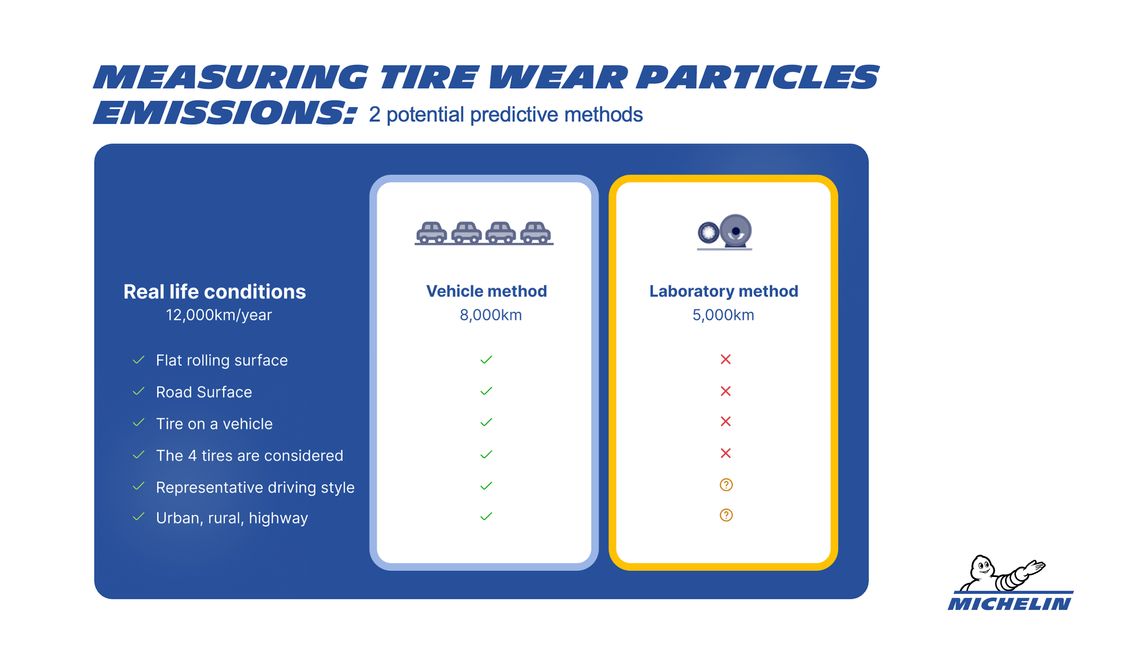
Ensuring the effectiveness of the Euro 7 regulation depends on the reliability of the measurement method. Two approaches are currently under discussion:
· Real-world on-road testing
this method measures emissions in grams per kilometer and per ton of load. It provides reliable, reproducible and representative results. Developed and supported by the European automotive industry for the last 6 years in full transparency with the authorities, it has been adopted by ADAC, the German automobile association, recognized for the stringency of its testing and whose outcomes are consistent with manufacturers’ own results, making this method the most robust cornerstone for the Euro 7 regulation.
· The lab-based drum method
Still under development, this alternative relies on partially defined and non-transparent parameters. This method is therefore open to manipulation to meet regulatory thresholds, and may not accurately reflect real emissions. In its June 2025 study, ADAC acknowledged that this approach is not yet sufficiently reliable for immediate implementation.
Discrepancies between these two methods are considerable: in 28% of cases, the results obtained for the same tire diverge sharply. For example, a tire measured with an abrasion index of 1.42 on the road would be banned from sale, while the same tire could be accepted in the laboratory with a result of 0.83.
Adopting the laboratory method immediately would entail substantial risks:
Economic risks, by encouraging the import of low-cost, less innovative tires into Europe;
Environmental risks, by severely undermining the effectiveness of Euro 7 regulations.
Michelin advocates for the immediate application of the real-world test method, while continuing research on a laboratory-based approach, which could ultimately serve as a complementary solution provided it reaches technical maturity.

Michelin, 20 years of innovation and R&D to reduce tire wear particles.
In June 2025, ADAC published a new study covering 160 tire models. The results show that Michelin tires emit, on average, 26% fewer particles than those of four other premium manufacturers. This performance confirms the results of a 2022 study, which already showed a 28% reduction compared with the market average.
Since 2005, Michelin has invested heavily in R&D to better grasp and reduce tire abrasion. Leveraging its expertise in materials science and with a design that focuses on optimizing the use of raw materials, the Group cut wear emissions by 5% between 2015 and 2020, avoiding the emission of 100,000 metric tons of particles.
In this context, Michelin will be ready to apply the Euro 7 regulation as early as 2028 for its new products, and in 2030 for all of its automotive ranges.
The ADAC study can be found at:
https://assets.adac.de/image/upload/v1749035559/ADAC-eV/KOR/Text/PDF/33478_dppcxx.pdf
** UN taskforce on tire abrasion data: https://wiki.unece.org/download/attachments/292257948/TA-32-10v1%20TAPP-19-08-RDW-Dataset-Technical-Analysis-R1.pdf?api=v2
About Michelin
Michelin is building a world-leading manufacturer of life-changing composites and experiences. Pioneering engineered materials for more than 130 years, Michelin is uniquely positioned to make decisive contributions to human progress and to a more sustainable world.
Drawing on its deep know-how in polymer composites, Michelin is constantly innovating to manufacture high-quality tires and components for critical applications in demanding fields as varied as mobility, construction, aeronautics, low-carbon energies, and healthcare.
The care placed in its products and deep customer knowledge inspire Michelin to offer the finest experiences. This spans from providing data- and AI-based connected solutions for professional fleets to recommending outstanding restaurants and hotels curated by the MICHELIN Guide.
Headquartered in Clermont-Ferrand, France, Michelin is present in 175 countries and employs 129,800 people.