Today, Michelin, the University of Poitiers, Grenoble Alpes University, Grenoble INP – UGA, and the CNRS are inaugurating the I-TireLab, a joint laboratory that combines data and modeling to create future innovations in tires, tire manufacturing, and flexible composites.
With a total investment of some €4.5M over four years, the project aims to bridge the gaps between academic research and industrial challenges.
Its four research themes will contribute to safer, higher-performing mobility, less resource-intensive manufacturing, and the development of new applications for flexible composites.
I-TireLab brings together Michelin's expertise in tire simulation and modeling, materials, and industrial processes and the expertise of the Laboratory of Computer Science and Automatic Control for Systems (LIAS – University of Poitiers) and the GIPSA-lab (UGA, CNRS, Grenoble INP – UGA) in modeling, system state estimation, and control methodology design.
It will provide a long-term framework for a partnership that has been operational for several years already, with the goal of turning data into knowledge, decisions, and actions.
The teams combine data analysis and modeling to represent and predict the behavior of tires, processes, and materials. They then assess the relevance and limits of those models by subjecting them to the challenges of data and experimentation.
Four research themes to achieve a better understanding of tires, optimize vehicles and manufacturing, and explore flexible materials
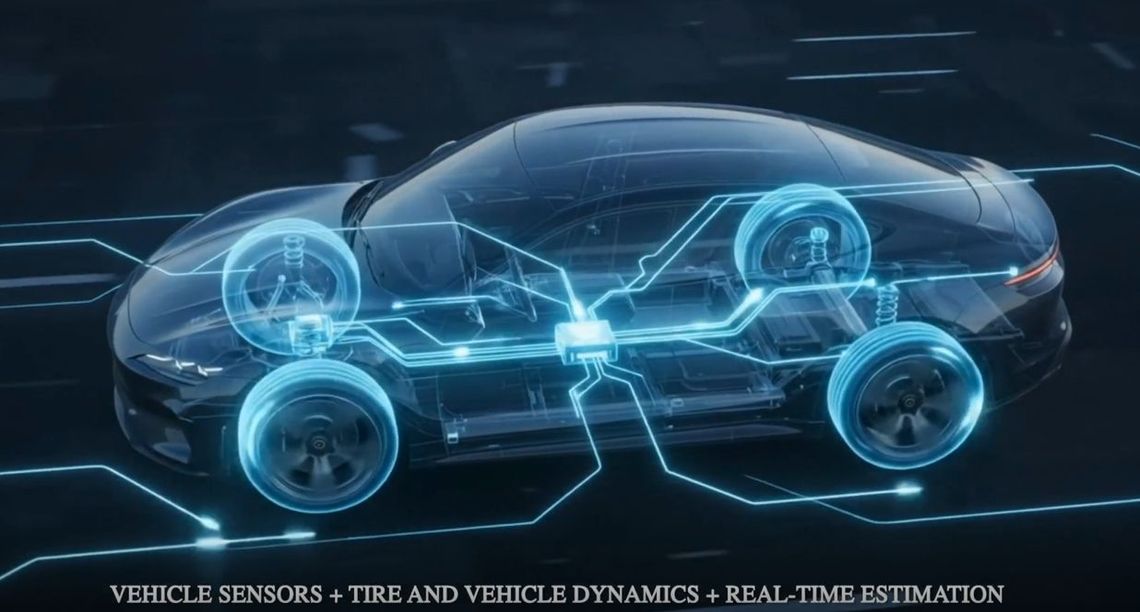
The 1st theme aims to achieve a better vision of tire status on the road. The teams’ projects include work on real-time estimates of tire wear and grip that leverage data from existing on-board sensors, with no need for specialized equipment.
The 2nd theme aims to incorporate that information into vehicle control systems. This research focuses on optimizing braking based on tire status and grip potential, with the ultimate goal of enhancing vehicle stability and efficiency.
The 3rd theme focuses on rubber manufacturing. Researchers are developing simulation and control tools to plan ahead for production equipment operation and optimize equipment settings. The goal is to maintain consistent rubber quality while limiting raw material waste and energy consumption.
The 4th theme explores ways of using flexible products to impact air and water flows around objects. Researchers are developing control laws to control changes to components’ shapes to modify flows.
Combining industrial and academic expertise to develop new methods and train researchers
The research carried out by the I-TireLab joint laboratory supports fundamental research that extends far beyond its target applications. Michelin contributes its understanding of product usage, its data, and its experimental and industrial resources. The academic laboratories contribute their theoretical and methodological expertise to design and validate new approaches. This collaboration will also help train young researchers working at the interface of fundamental research, experimentation, and industrial needs.
From tire digital twins to the Wisamo inflatable wingsail: real-world applications for researchers
Researchers have access to demonstrators and tests on partner sites so they can assess their methods in near-real-world conditions and potentially work on incorporating them into future Michelin innovation projects.
One of the planned applications for I-TireLab's research is to contribute to enhancing Michelin Touch Intelligence, the tire digital twin that Michelin presented in May 2026. This virtual replica of a tire combines data from vehicle sensors and Michelin models to estimate tire pressure, wear, load, and grip in real time, with no additional sensors and for all brands and models.
Research on certain types of flexible composites could also support future development of Wisamo, the inflatable, retractable automated wingsail developed by Michelin. The first Wisamo sail is currently in the delivery phase. Wisamo uses wind to boost ships’ propulsion systems and reduce their fuel consumption, providing an early practical example of how these technologies can be used. The methodology developed may contribute to further improvements to its functions and performance.
Visuals and photos available clicking here.
Quotes
Philippe Jacquin, Michelin General Manager & Director of Research and Development: “I-TireLab will make it possible to turn science into real-world innovations, from tires and tire manufacturing to tire-vehicle interactions. Michelin Touch Intelligence, the tire digital twin is one recent illustration of what that means in practice: when we know more about the tire’s status and grip potential, we can enable vehicle adjustments and optimization.”
Guillaume Mercère, I-TireLab Director, John Martinez-Molina, I-TireLab Co-Director, and Thibault Dairay, I-TireLab Co-Director: "I-TireLab brings together researchers, engineers, and young scientists to make mobility safer, improve our control of tire manufacturing, and explore new possibilities for flexible materials. By drawing on fundamental research, experimentation, and industrial needs, we are developing new methods, training talents, and preparing the innovations of the future, together.”
Mehdi Gmar, CNRS Deputy CEO for Innovation:“I-TireLab once again demonstrates that the expertise and knowledge developed in academic research laboratories—in this case, at GIPSA-lab in modeling and control of complex systems—have industrial applications. This is now the case with Michelin across very different areas: tires on the road, rubber manufacturing, and flexible materials supporting safer, more resource-efficient mobility.”
About
University of Poitiers
The University of Poitiers is a multidisciplinary institution dedicated to higher education, research, and innovation. It has nearly 31,000 students and 3,000 staff members across 14 academic divisions and 37 laboratories and research units. Mainly based in Poitiers and Châtellerault in the Vienne department, it also has campuses and sites in Charente, Charente-Maritime, and Deux-Sèvres. The University of Poitiers is undertaking major strategic projects to sustain and strengthen its role as a key player in education, research, and innovation. These projects are closely aligned with the areas in which the university operates and with its institutional, business, cultural, and academic partners. They also aim to mobilize the entire education–research–innovation continuum around three United Nations Sustainable Development Goals: "Good Health and Well-being" (SDG 3), "Quality Education" (SDG 4), and "Sustainable Cities and Communities" (SDG 11), through interdisciplinary collaboration and partnerships (univ-poitiers.fr).
Grenoble Alpes University – UGA
Grenoble Alpes University (UGA) is a leading multidisciplinary global research university. It is Europe’s top university for innovation by number of patents filed, appears in the Shanghai Ranking’s top 200, and is one of nine French universities to have received IDEX excellence initiative certification. With 57,000 students, including 10,000 international students and 3,000 doctoral students, and 12,000 faculty and staff members dedicated to research, education, and innovation, UGA has several campuses, mainly in Grenoble and Valence. Grenoble Alpes University is made up of seven component institutions: the University School of Technology; Grenoble INP - UGA; ENSAG - UGA; the School of Social Sciences and Territories; the Faculty of Humanities, Health, Sports, and Society; the Faculty of Sciences; and Sciences Po Grenoble - UGA. As center of a research and innovation ecosystem that is the only one of its kind in France, Grenoble Alpes University (UGA) works alongside its historic partners and now member institutions—the CEA, CNRS, INRAE, Inria, and Inserm— to coordinate cutting-edge research that also involves numerous external partners, including the IRD and Grenoble Alpes University Hospital. Its ambitions are structured around three pillars: the digital transition, the environmental transformation, and sovereignty (https://www.univ-grenoble-alpes.fr).
Grenoble INP - UGA
Grenoble INP - UGA, one of the component institutions of Grenoble Alpes University, is a public higher education institution that has been supporting businesses and society as they change for over a century. It boasts recognized scientific excellence, a historic culture of innovation, and a strong policy of social inclusion, and plays a key role in today’s major social and environmental challenges, contributing to building a sustainable world. Its eight schools of engineering and management train specialized and responsible students who have the skills they will need for the careers of the future. Its research professors are preparing for the future with cutting-edge research in some forty laboratories in France and worldwide (https://grenoble-inp.fr).
Michelin
Michelin is building a world-leading manufacturer of life-changing composites and experiences. Pioneering engineered materials for more than 130 years, Michelin is uniquely positioned to make decisive contributions to human progress and a more sustainable world. Drawing on its deep know-how in polymer composites, Michelin is constantly innovating to manufacture high-quality tires and components for critical applications in demanding fields as varied as mobility, construction, aeronautics, low-carbon energies and healthcare. The care placed in its products and deep customer knowledge inspire Michelin to offer the finest experiences. This spans from providing data- and AI-based connected solutions for professional fleets to recommending outstanding restaurants and hotels curated by the MICHELIN Guide. Headquartered in Clermont-Ferrand, France, Michelin is present in 175 countries and employs 122,600 people (www.michelin.com).
CNRS
A major player in basic research worldwide, the National Centre for Scientific Research (CNRS) is the only French organisation active in all scientific fields. Its unique position as a multi-specialist enables it to bring together all of the scientific disciplines in order to shed light on and understand the challenges of today's world, in connection with public and socio-economic stakeholders. Together, the different sciences contribute to sustainable progress that benefits society as a whole (www.cnrs.fr).
Participating laboratories
LIAS
LIAS, the Laboratory of Computer Science and Automatic Control for Systems, is a research laboratory affiliated with the University of Poitiers and ISAE-ENSMA. It operates at the intersection of information and communication sciences and technologies and engineering sciences, developing methods for modeling, analysis, and management of complex systems. Its research combines three complementary areas of expertise: automation, data and model engineering, and real-time on-board systems. LIAS works closely with its industrial partners to combine theoretical advances and real-world applications, particularly in energy, transportation, and the environment. Its participation in the I-TireLab joint laboratory alongside Michelin and the GIPSA-lab draws on its expertise in modeling, estimation, and controls for connected tires and rubber manufacturing processes.
GIPSA-lab
The GIPSA-lab is a research laboratory affiliated with Grenoble Alpes University, the CNRS, and Grenoble INP - UGA. It combines fundamental research and applications in automation, signal and image processing, language, cognition, robotics, and learning. It is home to 350 researchers, including close to 150 doctoral researchers, across 4 research departments. Its teams develop methods for understanding, modeling, and managing complex systems.
Press contact:
University of Poitiers Press Contact
Claire Vicario, Press Relations and Events Manager
claire.vicario@univ-poitiers.fr – +33 (0)6 72 48 00 67
Grenoble Alpes University Press Contact
Muriel Jakobiak-Fontana, Assistant Director of Communications
muriel.jakobiak@univ-grenoble-alpes.fr – +33 (0)6 71 06 92 26
Grenoble INP – UGA Press Contact
Elodie Auprêtre, Press Officer
e.aupretre@agence-mcm.com – +33 (0)7 62 19 83 09
Michelin Group Press Contact
Solenne Attias-Lemercier, Media Relations Department:
solenne.attias-lemercier@michelin.com – +33 (0)6 08 22 47 12
CNRS Press Contact
Manon Landurant, Press Officer:
manon.landurant@cnrs.fr – +33 (0)1 44 96 51 37